Tinubu Urges Africa to Remove Trade Barriers at Abuja Summit
President Ahmed Tinubu has called on African nations to dismantle outdated borders, modernize their Customs systems, and adopt a unified trade framework that can transform the continent’s economic prospects.
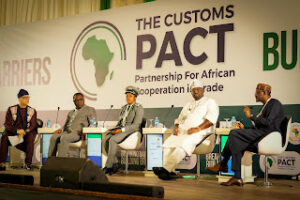
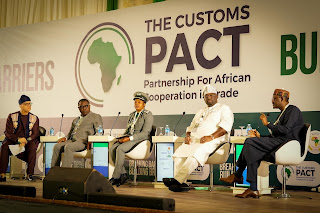
Speaking at the inauguration of the first Customs Partnership for African Cooperation in Trade (C-PACT) Summit at the State House in Abuja, Tinubu—represented by Vice President Kashim Shettima—said Africa’s economic success depends on coordinated reforms that turn its vast population and markets into a cohesive economic bloc. He emphasized that political will, institutional alignment, and the use of technology to ease trade processes are essential.
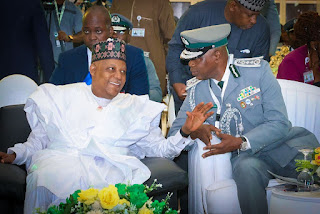
He noted that the administration’s economic reforms—including exchange-rate unification, fuel subsidy removal, port upgrades, and the digitalization of Customs—aim to create a globally competitive trade environment. Tinubu added that Nigeria’s National Single Window, launching in March 2026, will cut cargo clearance times from 21 days to under a week and fully align Nigeria with AfCFTA’s digital trade standards.
Tinubu urged African leaders to convert their commitments into measurable improvements that businesses can experience daily, stressing that true integration requires deliberate engineering.
The Comptroller-General of Customs, Adewale Adeniyi, said President Tinubu’s extension of his tenure included performance targets tied to AfCFTA implementation. He highlighted that the Nigeria Customs Service has strengthened engagement with Customs authorities across Africa over the past three months to ensure Customs is effectively integrated into AfCFTA structures.
Adeniyi referenced recent meetings in Ghana with the AfCFTA Secretariat, stressing that enforcing rules of origin, applying preferential tariffs, and managing trade preferences are core functions that will determine AfCFTA’s success. He noted that effective free trade agreements demand significant capacity building and political resolve, recalling how previous regional initiatives, such as the ECOWAS Trade Liberalisation Scheme, faltered due to inconsistent implementation.
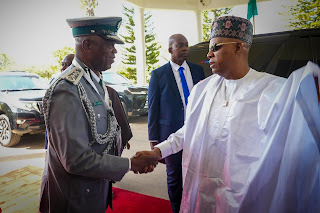
He acknowledged that African economies have different readiness levels, but recent consultations have built agreement that Customs must be central to AfCFTA execution. Adeniyi said his push for stronger Customs involvement led to the creation of C-PACT—a platform for direct collaboration among African Customs authorities, private-sector stakeholders, regulators, and international partners.
He reported that Nigeria’s exports have grown by over 30% in two years and stressed the need to channel more of this trade toward African markets where the economic impact would be greater. Adeniyi thanked AfreximBank, the AfCFTA Secretariat, the Nigerian Export Promotion Council, banks, the NPA, and other agencies for supporting trade facilitation. He also announced that 30 African Customs administrations registered for the summit, with 22 led by their Director-Generals, and noted the historic attendance of the World Customs Organisation’s Secretary-General at a Nigerian Customs event.
The conference will open with private-sector sessions focused on traders’ challenges such as non-tariff barriers, cargo delays, and inconsistent application of trade preferences.
Representing the Minister of Finance, Dr. Wale Edun, the Minister of State for Finance, Doris Anite, said Customs reforms are vital to Nigeria’s fiscal transformation. She explained that efficient border processes reduce business costs, enhance investor confidence, and strengthen Nigeria’s competitiveness. She also reaffirmed government support for full Customs digitization, improved risk profiling, and alignment with global standards.
Minister of Trade, Investment and Industry, Jumoke Oduwole, described AfCFTA as Africa’s most important economic tool but warned that outdated systems still slow its impact. She pointed to ongoing reforms with the Customs Service, including tariff concession schedules and a dedicated air-cargo export corridor to East and Southern Africa.
WCO Secretary-General Ian Saunders said Africa’s strong 2025 economic outlook hinges on Customs efficiency. Citing a WCO principle—“Borders divide; Customs connects”—he noted that C-PACT fits the WCO’s mission of supporting global Customs through standard-setting and capacity building.
AfreximBank’s Executive Vice President for Intra-African Trade, Kanayo Awani, said the bank is helping modernize Customs across Africa through transit-bond guarantees, digital tracking systems, and the AfCFTA Adjustment Fund, which supports countries facing tariff revenue shortfalls. She stressed that AfCFTA cannot succeed without harmonized and interoperable Customs systems.
AfCFTA Secretary-General Wamkele Mene added that implementing the agreement’s provisions on Customs cooperation, transit, and trade facilitation requires Customs leadership at every level. He commended Nigeria and the CGC for their leadership roles, emphasizing that Customs authorities are responsible for converting trade rules into efficient border practices that lower costs, reduce bureaucracy, and support African products in continental markets.
About The Author