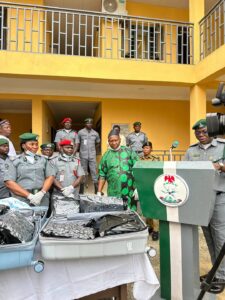

KLT Customs Drives Productivity Through Reforms, Collaboration
Despite declining trade volumes and operational challenges, the Kirikiri Lighter Terminal (KLT) Area Command of the Nigeria Customs Service (NCS) has continued to sustain operations through collaboration and innovative strategies aimed at boosting efficiency and service delivery.
The Acting Customs Area Controller, Deputy Comptroller Bolaji Adigun, disclosed that the Command is implementing strategic initiatives to improve cargo throughput, strengthen relationships with stakeholders, and enhance revenue generation.
According to him, collaboration remains central to the Command’s operations, especially because KLT depends heavily on transire cargo. He noted that regular engagement with shipping companies and parent ports is essential to maintaining steady cargo inflow.
Adigun explained that these partnerships have already yielded positive results, with increased vessel traffic recorded at Bestaf Terminal in recent months, leading to improved cargo inflow and operational activities.
He further stated that the Command is exploring ways to expand vessel operations to additional terminals, including BCTL, as part of efforts to reduce dependence on cargo transfers from major ports.
Speaking on revenue collection, Adigun stressed the importance of proper cargo examination, accurate valuation, and correct classification of goods to ensure appropriate duty payments. He noted that deploying officers effectively and adhering strictly to examination procedures would naturally improve revenue performance.
The Acting CAC also highlighted the impact of digitalisation on Customs operations, saying automation has simplified cargo processing, reduced congestion, and enhanced transparency and efficiency.
He added that officers are being monitored through regular parades, inspections, enforcement of dress codes, and unannounced supervisory visits to terminals in order to maintain discipline and professionalism.
While acknowledging challenges such as low trade volume and dependence on transire cargo, Adigun said the Command is responding with innovative and forward-looking strategies aimed at building stronger independent operational capacity.
He reaffirmed the Command’s commitment to stakeholders, assuring them that efforts are ongoing to achieve faster cargo clearance and more efficient service delivery, with a long-term goal of completing cargo clearance processes within 24 hours.