Customs Intercepts N43.59bn Cannabis, Codeine at Apapa
…seizes 7.6 tonnes of cannabis, 169,998 bottles of codeine, 108 drones.
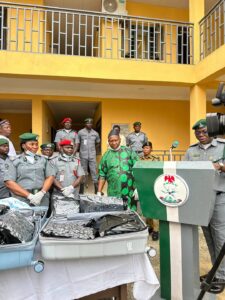
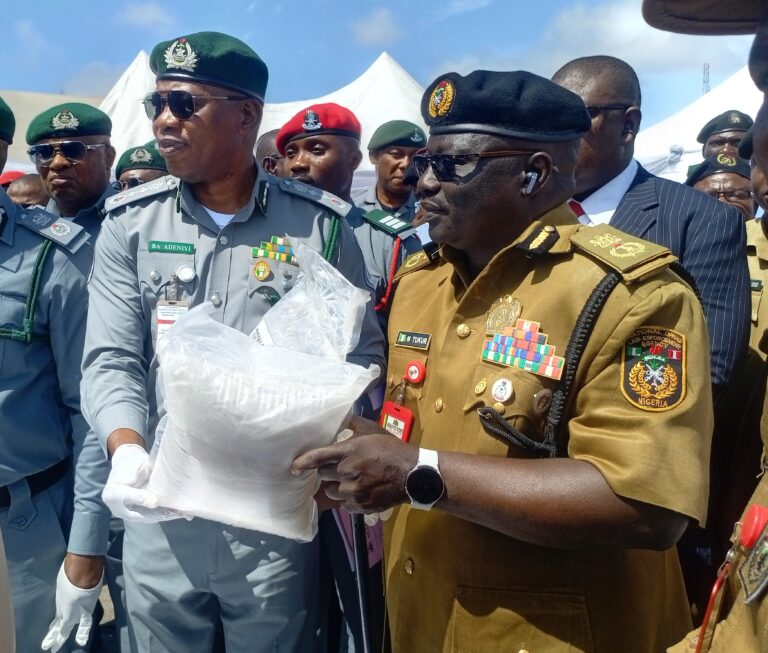
The Nigeria Customs Service (NCS) has intercepted 13 containers laden with 7,624kg of cannabis sativa, 169,998 bottles of codeine syrup, 108 high-definition dual-camera drones, used clothing and expired products at the Apapa Port, Lagos.
The consignments, according 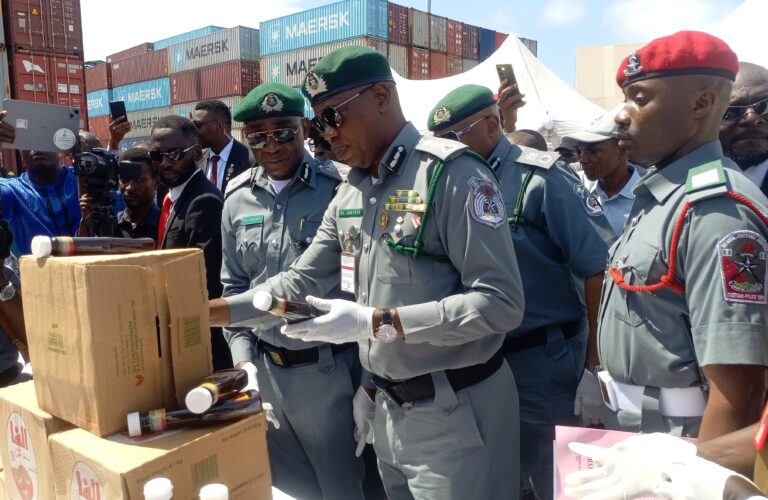 to the Comptroller-General of Customs, Adewale Adeniyi, have a combined duty-paid value (DPV) of N43.59 billion.
Adeniyi disclosed this on Thursday at a press briefing on seizures recorded by the Apapa Area Command, attributing the interceptions to sustained intelligence-led operations, enhanced cargo profiling and stronger collaboration with national and international security agencies.
He said the Nigeria Customs Service Act, 2023, had expanded the Service’s mandate beyond revenue collection to securing the supply chain, protecting the nation’s borders and ensuring the safety of goods entering the country.
“The revenue is the part of our work that is counted publicly each quarter. The other part is measured in what never reaches the street, and it is that part I am reporting today,” Adeniyi said.
According to him, criminal networks were becoming increasingly sophisticated in concealing illicit goods in legitimate consignments, making intelligence-led targeting and risk assessment critical to effective port enforcement.
He said narcotics were being concealed in vehicle spare parts and used vehicles, controlled drugs hidden beneath household items, while restricted equipment was sometimes falsely declared as ordinary electronics.
Adeniyi said the Service had strengthened its cargo profiling and risk-assessment systems across its commands, while the deployment of the B’Odogwu platform had improved the integration of trade data into the Customs assessment process.
He also disclosed that the establishment of an INTERPOL Data Centre at the NCS headquarters in Abuja in July had further strengthened the Service’s intelligence-gathering capacity.
According to him, the centre is the eighth INTERPOL Data Centre in Africa and gives Customs officers access to more than 152 international databases.
He listed enhanced cooperation with the National Drug Law Enforcement Agency (NDLEA), the National Agency for Food and Drug Administration and Control (NAFDAC), the Office of the National Security Adviser and international security partners as key to the recent interceptions.
7.6 tonnes of cannabis seized
Giving details of the seizures, Adeniyi said three containers were found to contain 15,245 parcels of cannabis sativa weighing more than 7.5 tonnes.
The first consignment, in 40-foot container HAMU 3086682, contained 4,777 parcels weighing 2,388.5kg. The cannabis was concealed in two cartons, 48 jumbo bags and 40 drums alongside automobile spare parts, coffee mix, oats and three vehicles.
The second container, FANU 1933352, contained 8,287 parcels weighing 4,145kg and packed in 162 bags. Three vehicles were also found in the container.
The third narcotics container, MSKU 3941778, a 20-foot container, contained 2,181 parcels weighing 1,090.5kg.
The container also held 148 bags of foreign parboiled rice, automobile spare parts, lithium batteries, a photovoltaic combiner box, turmeric, mangala fish and butterfly fish.
Adeniyi attributed the cannabis seizures to intelligence sharing and operational cooperation between the NCS, NDLEA and international security partners.
169,998 bottles of codeine
Customs also intercepted 40-foot container TCKU 7653306, containing 1,700 cartons of codeine syrup comprising 169,998 bottles.
The pharmaceutical consignment was concealed beneath household items.
Adeniyi described the abuse of prohibited substances, particularly codeine among young Nigerians, as a major national concern with serious consequences for individuals, families and society.
108 drones intercepted
In another seizure, Customs officers intercepted 108 high-definition dual-camera drones in container MSKU 9282528.
While acknowledging the legitimate uses of drones, Adeniyi warned that security-sensitive equipment could pose serious risks if placed in the wrong hands.
He urged importers of such equipment to obtain the necessary security approvals, end-user certificates and other documentation before shipment.
“Restricted and security-sensitive equipment requires the appropriate security approvals, end-user certificates and documentation before clearance. Consignments of that character that arrive without them will be detained,” he warned.
Customs seizes 1,282 bales of used clothing
The Service also intercepted three containers containing 1,282 bales of used clothing.
The consignments comprised 425 bales in MRKU 6185100, 435 bales in MRKU 5539966 and 422 bales in SEKU 4685299.
Five additional containers were found to contain expired products, including tomato ketchup, antiseptic liquid, vaginal tablets and disposable nappies.
The Customs chief warned that importing expired products intended for human consumption or household use posed serious health risks to Nigerians.
“These are products applied to the body and consumed by households. Their importation after expiry places children, women and other consumers at risk of harm they have no means of detecting at the point of purchase,” he said.
The seized narcotics and controlled pharmaceutical products were subsequently handed over to the NDLEA and NAFDAC respectively for further investigation and action.
Customs vows tougher action
Adeniyi assured legitimate traders that the intensified enforcement operations would not undermine lawful commerce, stressing that the Service remained committed to facilitating legitimate trade.
He warned those involved in false declaration, concealment, undervaluation and the importation of prohibited goods that Customs would continue to target their activities.
“To those engaged in false declaration, concealment, undervaluation or the importation of prohibited goods, the position is straightforward: no port, border station or logistics channel will be permitted to serve as a safe haven,” he said.
He urged importers and other stakeholders to use Customs compliance mechanisms, including the Advance Ruling system, which enables traders to obtain the Service’s position on classification, valuation and origin before shipment.
He also encouraged compliant operators to enrol in the Authorised Economic Operator (AEO) programme, which provides more predictable clearance and fewer interventions where risk assessment permits.
“Compliance is not an obstacle to business; it is an advantage over competitors who lack it,” Adeniyi said.
The Comptroller-General commended officers and men of the Apapa Area Command for their vigilance and professionalism, while appreciating the NDLEA, NAFDAC and international partners for their cooperation in the successful interceptions.