
Nigeria, Benin Customs Push Joint Border Post at Seme-Kraké
Nigeria and Benin are moving to integrate operations at the Seme-Kraké border as both countries intensify efforts to remove trade bottlenecks and facilitate the movement of goods and people along the Abidjan-Lagos Corridor.
The initiative centres on the proposed Joint One-Stop Border Post, which is expected to harmonise Customs procedures, strengthen border security and reduce delays for legitimate traders.
The latest step came on Friday, September 11, 2026, when officials of the Nigeria Customs Service (NCS) and the Benin Customs Administration jointly assessed the infrastructure and operational readiness of the proposed facility.
The exercise, tagged “Joint Nigeria-Benin Republic One-Stop Border Post Assessment at Seme-Kraké,” was themed “Leveraging the Nigeria Customs Service Trade Modernisation Project to Advance Seamless Cross-Border Trade and Shared Prosperity.”
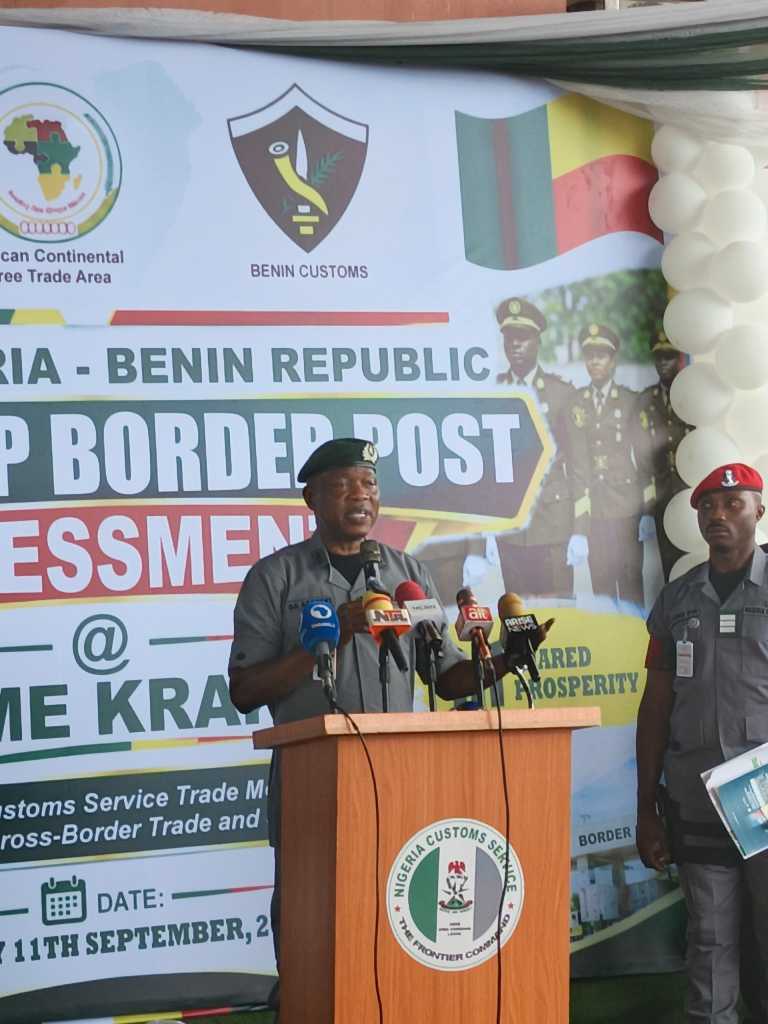
Speaking at the event, the Comptroller-General of Customs, Adewale Adeniyi, described Seme-Kraké as a critical trade gateway and one of the busiest land borders in West Africa.
He said the crossing was particularly important because the Abidjan-Lagos Corridor handles more than 70 per cent of transit trade in the sub-region.
Adeniyi said delays at the border affected not only Customs operations but also businesses, travellers and consumers across the region.
“Every hour lost at this gate is multiplied across thousands of consignments and tens of thousands of travellers,” he said, adding that reducing delays at Seme-Kraké would have benefits far beyond the border itself.
The CGC said one of the major gaps confronting both countries was the absence of full digital interoperability between their Customs systems.
He disclosed that the NCS was working towards a common data-exchange arrangement that would allow both administrations to access declarations, manifests, transit information, risk profiles and enforcement alerts in real time.
The proposed system, he said, would also enable transit cargo to be tracked from its point of origin to its final destination, improving both trade facilitation and enforcement.
Adeniyi also drew attention to the contribution of informal traders, particularly women, to cross-border commerce. He said women account for more than 70 per cent of informal cross-border traders in Africa, with the trend particularly evident along the Nigeria-Benin corridor.
He said about 22 per cent of Benin’s informal exports are destined for Nigeria, while informal trade represents an estimated one-fifth of economic activity in Nigeria and an even larger share in Benin.
The Director-General of the Benin Customs Administration, Raouf Malehossou, said the proposed border post represented an important step towards deeper economic integration between the two countries.
He said the initiative would allow both administrations to improve risk management by identifying and addressing threats before they become major security or trade problems.
Malehossou, however, stressed that infrastructure alone would not guarantee an efficient border.
He said success would depend on effective coordination between agencies, digital integration, clearly defined responsibilities and continuous investment in Customs personnel.
He urged the technical teams from both countries to identify existing gaps and develop practical solutions capable of meeting future trade demands.
The Benin Customs chief said the ultimate goal was to establish a border system based on shared facilities, harmonised procedures and joint controls.
He described the project as a key component of efforts to strengthen regional integration under ECOWAS and unlock the full trade potential of the Abidjan-Lagos Corridor.
“Our historic responsibility now is to ensure that the movement of people and goods across this corridor is as efficient and seamless as the infrastructure allows,” Malehossou said.
He urged both sides to move quickly from assessment to implementation, saying, “Let us therefore get to work.”